


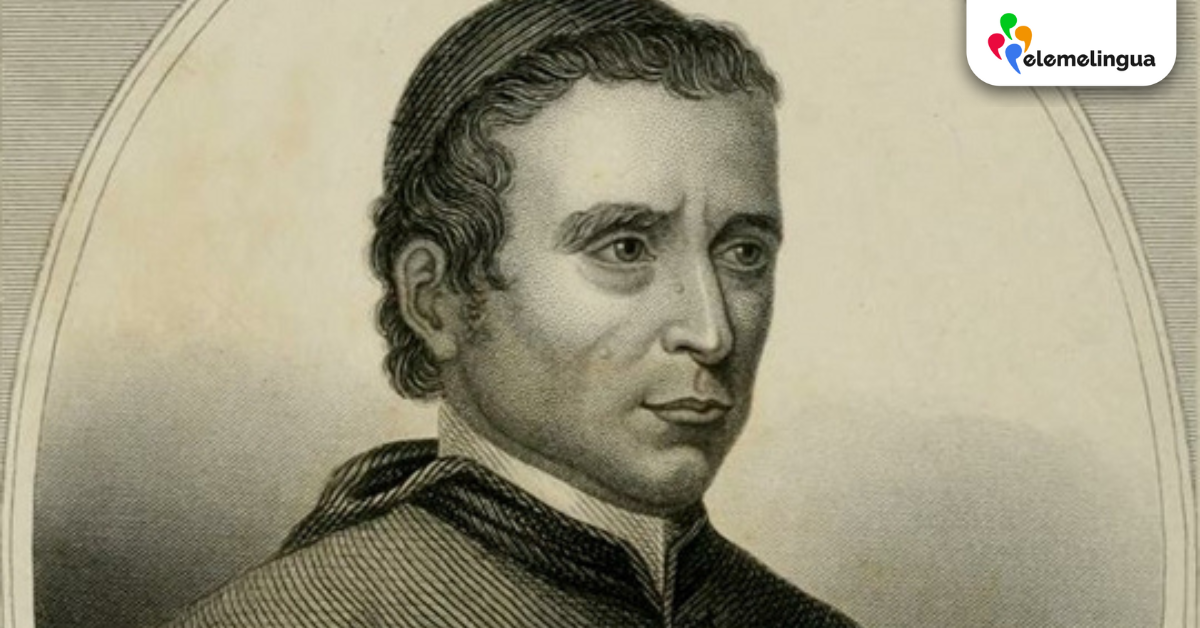


How many languages can one person learn in a lifetime? Five? Ten? Or maybe a hundred? Has anyone ever been tested for so many languages? If you’re asking yourself these kinds of questions, you should know the story of Cardinal Giuseppe Gaspar Mezzofanti (who lived from 1774 to 1849).
An Extraordinary Child
Mezzofanti spent most of his life in Bologna. There, he was also ordained a priest. At the University of Bologna, he worked as a professor of oriental languages and as a librarian. Then, in 1831, he moved to Rome, where he became curator of the Vatican Library. In 1838, Pope Gregory XVI appointed him as cardinal. That’s a few short dry facts.
When Giuseppe Gasparo was still a boy, his father, Francesco Mezzofanti, was a carpenter and his workshop where he did his craft was in the open street. Apparently, the place where the young man helped his father was located opposite the windows of a school run by an old priest who taught Latin and Greek. Little Giuseppe did not know the Greek alphabet, or even the alphabet of his own language, but when he heard a lesson, he immediately picked up every Greek and Latin word. He succeeded even though he had never once seen Greek or Latin textbooks! Fortunately, the teacher found out about it. He took the boy from the workshop and allowed him to continue his education.
He knew a few dozens of languages
When Mezzofanti was asked how many languages he knew, he usually replied: “Fifty and Bolognese.” Most researchers agree that there were several dozen. Based on the memoirs of foreigners who personally met the polyglot, his biographer C.W. Russell divided the languages he knew into four categories:
1) languages that Mezzofanti spoke perfectly,
2) those in which he spoke well,
3) those in which he communicated freely, but with errors,
4 ) languages in which he could only speak a few sentences and initiate a conversation.
In the first category, Russell included the following: Albanian, English, Arabic, Armenian (ancient and modern), Chaldean, Chinese, Czech, Danish, Flemish, French, Greek, Hebrew, Spanish, Illyrian, Coptic, Latin, Maltese, Dutch, German, Persian, Polish, Portuguese, Russian, Swedish, Turkish, Hungarian and Italian.
In the second group were: Syrian, Gyez, Amharic, Hindustani, Gujarati, Basque, Wallachian, Californian and Algonquian. There were eleven more languages in the third category and eight languages in the fourth category. To this list, we could add various dialects.
Linguistic Marvel
In 1817, during his return trip from Rome to Venice, Lord Byron, one of the most famous representatives of English literature of the Romantic era, stopped in Bologna. There, he met the polyglot, and later wrote of Mezzofanti: “The man might have lived in the time of the Tower of Babel and acted as an all-encompassing interpreter there . . . I tested him in all the languages in which I knew a single oath or phrase. And he, oh fate! He amazed me – shocked me, even in my native English!” According to Father Gaume, when in a conversation with the Bologna priest Byron exhausted the words taken from English slang, Mezzofanti began to show off sophisticated examples of London jargon, previously unknown to Byron, and yet the poet had such a rich vocabulary!
On another occasion, a group of Irish seminarians traveled to Rome. They decided to stop in Bologna to meet the famous polyglot in person. They arrived in town in the late afternoon. The next morning they intended to move on, so they decided to go straight to the university library, where they expected to find Mezzofanti. But, as might be expected, the library was closed at such a late hour, so there was silence in the deserted galleries. The clerics wandered around for a long time, looking for someone who could help them. Eventually they saw a man of humble insight approaching them. One of them stepped out of the group and, in the best Latin he could muster, asked him for directions to the library premises.
- “Would you like to see the library?” The stranger answered him immediately in English, with a perfect accent.
The cleric stood frozen.
- “By Jupiter, boys!” he exclaimed to his companions. “That’s Mezzofanti himself!”
In fact, it was Mezzofanti. Upon learning that they were Irish, he addressed them in their native Irish language, but they had to admit that they could not answer him. Only one cleric knew Irish from books. Mezzofanti struck up a conversation with him about alleged Irish-Welsh analogies. For the sake of clarity, it’s important to know that in the first half of the 19th century English had already largely supplanted the native language of Ireland, and only a quarter of the inhabitants of the island spoke Irish.
Foreigners often subjected Mezzofanti to various tests
In 1819, the Emperor of Austria, Francis I, visited Bologna; and before he had an audience with the polyglot, he took care of the appropriate selection of members of his entourage – the point was that they should represent the main languages of the Austrian Empire. So, successively, Germans, Hungarians, Czechs, Vlachs and Poles took advantage of the opportunity to talk to Mezzofanti. He answered each one of them so fluently and correctly that, as his biographer recalled, he received not only approval, but also admiration and applause.
Another monarch who met with the polyglot was Tsar Nicholas I of Russia. In Rome, the Tsar spoke to him in Russian and Polish. He later confessed that he had not noticed any foreign accent in the learned cardinal’s speech. Mezzofanti, on the other hand, had some remarks regarding the purity and elegance of the style in which the emperor spoke Polish.
Also, another test was put to him by Bucheron, a professor of Latin literature at the University of Turin. Bucheron believed that it was impossible for a man focused on so many languages to know them thoroughly. So, when he visited the library where the polyglot worked, he prepared in advance a number of specialized questions about Latin. He assumed that he would ask them casually during the conversation. As planned, he quickly and skillfully steered the initially trivial discussion into complex issues. Mezzofanti passed the test with flying colors. As the professor was leaving the library, he met the librarian Ferrucci. The latter asked him about the impression Mezzofanti had made on him. “Per Bacco! Bucheron replied in astonishment. – Per Bacco! E il Diavolo! (O Bacchus! It’s the devil!)
Any Learning Opportunity is Good
The polyglot used every opportunity to learn new languages. When subsequent wars swept through the Italian lands in the last decade of the 18th century, Mezzofanti was a young priest and served in military hospitals, which quickly filled up with sick and wounded soldiers – representatives of various European nations. He later recalled:
“I kept meeting Hungarians, Slavs and Germans who had been wounded in battles or were invalids, and I felt pain for their fate, as well as for not being able to communicate with them. I was unable to hear the confessions of the Catholics present, or to reunite with the Church those who were separated from it. So, I tried my best to learn the language of a patient, until I had studied it well enough for us to understand each other.”
In this way, the Bologna priest mastered, among others, Hungarian, Czech and Polish. In turn, he learned the Gypsy (Roma) language thanks to a soldier from a Hungarian regiment, who was quartered in the city.
It seems that the polyglot had an instinctive ease in understanding the most important structural features of languages, which enabled him to learn each of them more quickly and start his first conversations. On the other hand, his perfect memory did not forget any word, phrase, idiom, or even sound that it had previously recorded. Additionally, when Mezzofanti was alone, he used to think in each of the languages he knew, so that even without the presence of another person he could enjoy the practice of conversation.
Work, simplicity, passion
Mezzofanti lived modestly and slept only a few hours a day. He got up just after four, regardless of the season. After morning prayer and meditation, he would say Mass, then drink a cup of hot chocolate or coffee. At eight o’clock, he would give his daily lecture at the university, then go to the library. In the library, he devoted himself to his duties. Although, he was often interrupted by the visits of curious strangers.
At twelve o’clock, he ate a modest dinner in his apartment in the library building. After eating, he went back to work and spent the afternoon giving private lessons. His dinner consisted of something simple. He studied late into the night and always read for a short time in bed before going to sleep. Only when drowsiness overcame him did he feel that he could rest without the fear that he was wasting precious time.
Mezzofanti is regarded as a model for those who devote themselves to self-education. It turns out that even exceptional language skills require dedication, patience and constant effort in order to develop. This was revealed by him in the feverish diligence with which he collected and analyzed grammar rules, dictionaries, textbooks, reading books, and other learning tools. He also took every opportunity to talk to foreigners in foreign languages. It is known that he did not act superior nor was he prone to complaining. He simply focused on his work.
How did he do it?
Mezzofanti did not leave any work in which he would explain in posterity his system of effective language learning. It remains to be confirmed whether it was the result of combining talent and excellent memory, with passion and consistent study. However, the words that the polyglot once said to his friend, Mr. Libri, might lift the veil of secrecy:
“Language learning is easier than it is commonly believed, because there are a limited number of points to which special attention must be paid in all languages; and if one masters these elements, the rest will be easy for him to learn.”
